Most of the time you don’t need a test kit. The date tells you whether a U.S. coin should be silver, and the edge and the weight confirm it. A magnet, an ice cube and a ring test add a little, but none of them can tell a silver quarter from a clad one on its own.
Work through the checks in this order. The first two take ten seconds and settle most coins.
Which U.S. coins are silver?
Congress took silver out of dimes and quarters with the Coinage Act of 1965, so the first clad coins carry a 1965 date. The half dollar kept some silver until 1970. This table lists every circulating U.S. coin that contains silver, with today’s melt value from the live spot price.
| Coin | Silver years | Silver | Silver per coin | Melt value today |
|---|---|---|---|---|
| Dime (Mercury, Roosevelt) | 1964 and earlier | 90% | 0.0723 oz | … |
| Quarter (Washington and earlier) | 1964 and earlier | 90% | 0.1808 oz | … |
| Half dollar (Walking Liberty, Franklin, 1964 Kennedy) | 1964 and earlier | 90% | 0.3617 oz | … |
| Kennedy half dollar | 1965 to 1970 | 40% | 0.1479 oz | … |
| Jefferson “war nickel” | 1942 (some) to 1945 | 35% | 0.0563 oz | … |
| Morgan and Peace dollars | 1935 and earlier | 90% | 0.7734 oz | … |
A few non-circulating coins are silver too. Eisenhower dollars with an S mint mark from 1971 to 1974, and the 1976-S Bicentennial quarter, half and dollar sold to collectors, are 40% silver. Dimes, quarters and halves in U.S. Mint silver proof sets are 90% silver from 1992 through 2018 and 99.9% from 2019 on. The Ike dollars and halves you find in circulation from 1971 on are copper-nickel.
Don’t assume a 1964 date means the coin was made in 1964. The Mint kept striking 1964-dated silver coins into 1965 and 1966, which is one reason 1964 coins are so common.
Want to check a specific coin? Our Is My Coin Silver? tool lets you pick the coin and year and shows the silver content and melt value.
1. Look at the edge
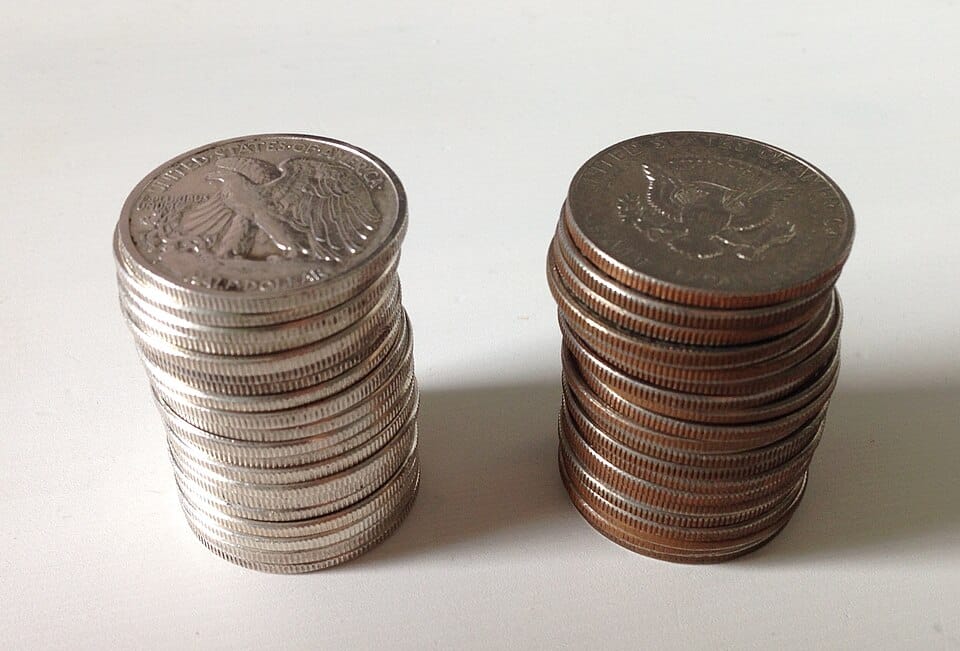
This is the fastest physical test. Clad dimes, quarters and halves are copper-nickel layers bonded to a pure copper core, and the copper shows as a reddish stripe around the edge. A 90% silver coin has a solid, silver-white edge all the way through.
In the photo at the top of this page, the stack of silver Walking Liberty halves is white on the edge, and the clad halves beside it show copper.
The 40% Kennedy halves are an exception. A 1965 to 1970 Kennedy half is 40% silver, and its outer layers are 80% silver, so its edge also looks silver. If a Kennedy half has a silver edge, check the date to tell 90% from 40%.
2. Check the date and mint mark
With the table above, the date settles most coins. War nickels and Kennedy halves need a second look.
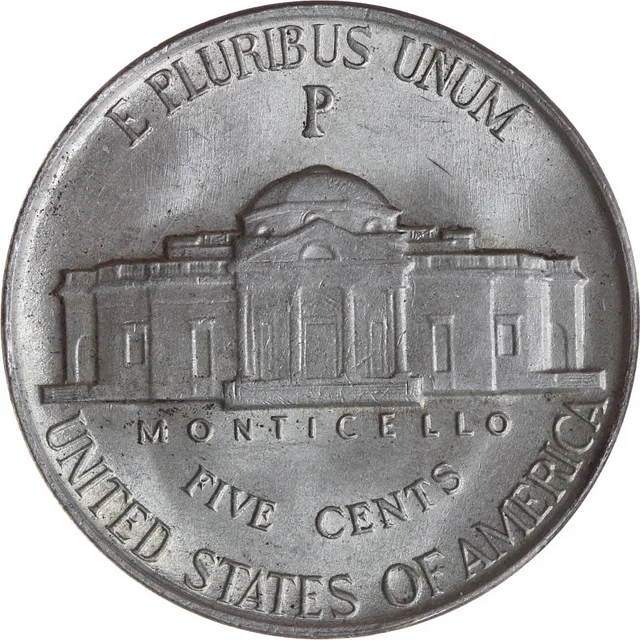
From late 1942 through 1945 the Mint swapped nickel for silver, which it needed for the war. To mark the new alloy it moved the mint mark to a large P, D or S above Monticello’s dome. The Philadelphia “P” was the first time that mint’s mark appeared on a U.S. coin. A 1942 nickel with a small mint mark beside the building, or no mint mark, is regular nickel.
Kennedy halves dated 1964 are 90% silver, 1965 to 1970 are 40%, and 1971 and later have none.
3. Weigh it
Silver is heavier than the copper-nickel that replaced it, so a scale that reads to 0.01 gram tells silver from clad for certain. This is also how the rare 1965 quarters and dimes struck on leftover silver blanks get spotted.
| Coin | 90% silver | 40% silver | Clad |
|---|---|---|---|
| Dime | 2.50 g | — | 2.268 g |
| Quarter | 6.25 g | — | 5.67 g |
| Half dollar | 12.50 g | 11.50 g | 11.34 g |
| Eisenhower dollar | — | 24.62 g | 22.68 g |
Worn coins weigh a little less than new ones, so a well-circulated silver quarter might read 6.1 or 6.2 grams. That’s still well clear of a clad quarter’s 5.67. The 40% half and the clad half are only 0.16 gram apart, so read the date as well.
A cheap kitchen scale isn’t fine enough for dimes. A pocket jewelry scale that reads to 0.01 g costs about the same and works for every coin here.
4. Try a magnet
Silver isn’t magnetic. Hold a strong magnet (a neodymium magnet works best) against the coin. If it sticks, the coin has iron, steel or nickel in it and isn’t silver.
What the magnet can’t do is prove a coin is silver. Copper and copper-nickel don’t stick to magnets either, so a clad quarter and a silver quarter react the same way. APMEX’s guidance puts it the same way: sticking means fake, not sticking proves nothing. The magnet is most useful for catching steel-cored fakes of silver dollars and bullion rounds, and for sorting Canadian 1968 dimes and quarters (more on those below).
5. Listen for the ring
Balance a coin on a fingertip and tap it gently with another coin. Silver gives a high, clear ring that hangs in the air for a second or more. Copper-nickel and base-metal fakes give a shorter, duller clink.
The ring test works best when you compare against a coin you know is silver of the same size. It’s quick and harmless, but it takes some practice to hear the difference, and it tells you little about worn or damaged coins.
6. The ice test
Silver conducts heat better than any other metal, so an ice cube set on a silver coin starts melting almost as soon as it touches. On a clad coin it melts more slowly.
The trouble is that copper is nearly as good a conductor, so a thick silver plating over copper can pass. APMEX calls the ice test unreliable on its own. Treat it as a party trick and rely on the edge and weight tests.
7. Let a coin shop test it
If a coin is old, foreign or might be valuable, take it to a coin shop instead of testing it yourself. Most dealers will tell you whether a coin is silver in under a minute, usually for free. Some have an XRF analyzer, which reads the metal’s composition from the surface without marking the coin.
Don’t use acid on a coin you might sell to a collector. An acid test scratches or etches the surface to work, and that damage cuts collector value. It also only tells you roughly what the surface is made of. Acid testing is meant for scrap and jewelry.
Find a coin shop near you and bring the coins you’re unsure about.
Which test should you use?
| Test | What it tells you | Good for | Can it be fooled? |
|---|---|---|---|
| Date and mint mark | Whether the coin should be silver | All U.S. coins | Only by errors and fakes |
| Edge | Clad copper core vs. solid silver | Dimes, quarters, halves | No for clad; 40% halves look silver too |
| Weight (0.01 g scale) | Silver vs. clad, transitional errors | Everything | Hard to fool; wear shaves a little |
| Magnet | Rules out iron, steel and nickel | Bullion, dollars, fakes | Clad passes too |
| Ring | Silver vs. base metal | Bullion coins, dollars | Needs a reference coin and practice |
| Ice | Very rough heat-conduction check | Thick bullion pieces | Yes, by copper cores |
| XRF at a coin shop | Surface composition | Anything doubtful | Plated fakes can read as silver on the surface |
| Acid | Surface metal | Scrap and jewelry only | Damages the coin |
Foreign coins: Canada and the UK
Canada’s 10, 25 and 50 cent coins and dollars were 80% silver from 1920 through 1966. In 1967 they were struck in both 80% and 50% silver, and 1968 dimes and quarters come in 50% silver or pure nickel. Pure nickel is magnetic, so a magnet sorts the 1968 coins: if it sticks, it isn’t silver. Canada’s circulating coins from 1969 on contain no silver.
Britain cut its silver coins from 92.5% to 50% silver in 1920 and switched to cupro-nickel with coins dated 1947. Maundy money stayed sterling.
Fake silver coins
Fakes come in two kinds. Cheap ones are silver-plated base metal, and the weight or a magnet usually gives them away. Better counterfeits of Morgan dollars and trade dollars, many made in China, are struck in real silver at the right weight. NGC has documented die-struck Chinese Morgans that pass the basic tests. Those only show up under a dealer’s or grading service’s eye, through details like the wrong date and mint combination or soft design details.
Under the Hobby Protection Act, a replica coin made in or imported into the U.S. has to be plainly and permanently marked “COPY.” A coin with “COPY” stamped on it is a souvenir, whatever it looks like.
What to do with the silver you find
Sort what you have into piles: 90% silver, 40% halves, war nickels, and clad. Our junk silver calculator turns the face value of each pile into ounces and a melt value, and the junk silver value guide explains what dealers pay against that number. Before you sell anything for melt, check the date list in our coin pages: a few dates, like the 1916-D Mercury dime, are worth far more to collectors than their silver.
Common questions
What years are quarters silver?
Washington quarters dated 1932 through 1964 are 90% silver. Quarters dated 1965 and later are copper-nickel clad, except collector issues such as the 40% silver 1976-S Bicentennial quarters and silver proof-set quarters from 1992 on.
Are 1965 quarters silver?
Almost never. 1965 is the first clad year. A small number of 1965 quarters were struck by mistake on leftover 90% silver blanks; they weigh 6.25 grams instead of 5.67. PCGS reports one graded XF45 selling for $9,300 in 2022, so a 1965 quarter that weighs 6.25 g is worth getting authenticated.
How can I tell if a dime is silver without a scale?
Check the date (1964 or earlier for Roosevelt dimes, and every Mercury dime) and look at the edge. A silver dime has a solid silver-white edge; a clad dime shows a copper stripe. Stacked side by side, silver dimes also look whiter and duller than clad ones.
Does a magnet stick to silver coins?
No. Silver is very weakly repelled by a magnet. But copper and copper-nickel aren't magnetic either, so a magnet can't tell a silver quarter from a clad one. It only catches fakes with iron or steel in them, plus Canadian 1968 pure-nickel dimes and quarters.
Are war nickels really silver?
Yes. Jefferson nickels struck from October 1942 through 1945 are 35% silver, 56% copper and 9% manganese. You can spot them by the large P, D or S mint mark above Monticello's dome on the back.
Are Kennedy half dollars silver?
1964 Kennedy halves are 90% silver. 1965 through 1970 halves are 40% silver. 1971 and later circulation halves contain no silver.
Does the ice test prove a coin is silver?
No. Silver conducts heat better than any other metal, so ice melts fast on it, but copper is close behind. A silver-plated copper fake can pass. APMEX calls the ice test unreliable on its own.
Where can I get a coin tested for silver?
Most coin shops will check a coin for free in a minute or two by date, weight and edge, and some have an XRF analyzer that reads the metal without harming it. Use our directory to find a coin shop near you.
Where to buy
Online dealers for gold and silver
When a local shop doesn't have what you want, these established online dealers ship insured nationwide.
APMEX
One of the largest U.S. online bullion dealers, trading for 20+ years with 1M+ customers.
- Gold & silver coins, bars and rounds
- Live prices tied to spot
- Insured shipping to your door
Bullion Exchanges
Online precious-metals dealer with a deep catalog of bullion coins and bars.
- Gold, silver & platinum bullion
- Government-minted coins and private bars
- Ships nationwide
Keep going
Sources
- Wikipedia: Coinage Act of 1965
- Wikipedia: Roosevelt dime (weights, silver proof sets)
- Wikipedia: Washington quarter (weights, 1976 silver collector issues)
- Wikipedia: Kennedy half dollar (90%, 40% and clad specifications)
- Wikipedia: Jefferson nickel (wartime 35% silver alloy and mint marks)
- Wikipedia: Peace dollar
- Wikipedia: Eisenhower dollar (40% silver S-mint collector issues)
- Wikipedia: Silver (density, thermal conductivity, diamagnetism)
- PCGS: The 1966 silver Washington quarter, and 1965 transitional silver sales
- APMEX: How to tell if your silver is real or fake
- APMEX: Does silver melt ice?
- Thermo Fisher: Numismatic testing methods (acid, XRF)
- Wikipedia: Coins of the Canadian dollar (1920 and 1968 alloy changes)
- Money Metals: What Canadian coins are silver?
- Royal Mint Museum: Consequences of the Second World War (1947 cupro-nickel coinage)
- NGC: Counterfeit detection, Morgan dollars